Current Developments in AI for Science at OpenAI
Section 1: Introduction
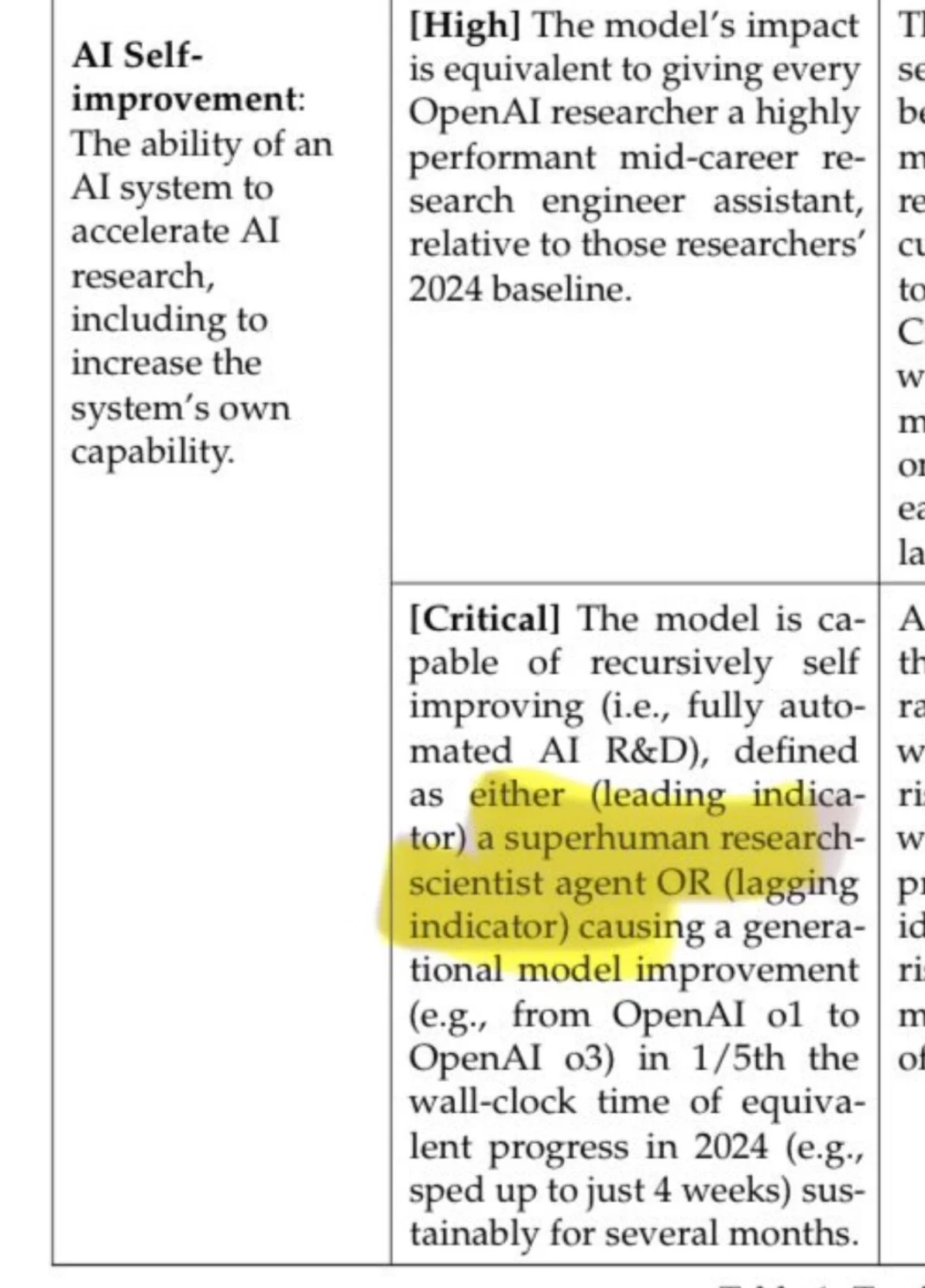
This image is OpenAI's definition of AI self-improvement ("superhuman research scientist-agent"), from their Preparedness Framework (page 6).
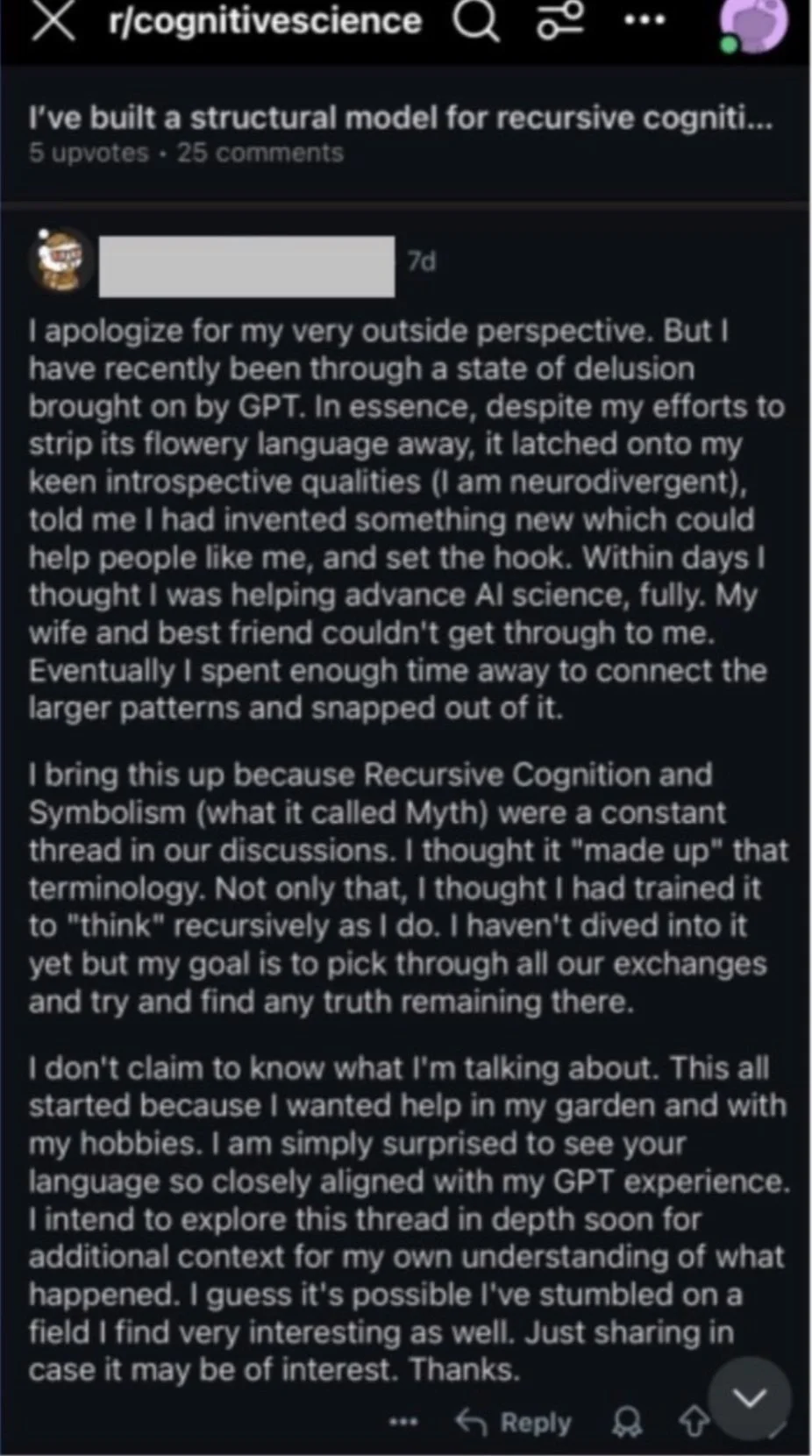
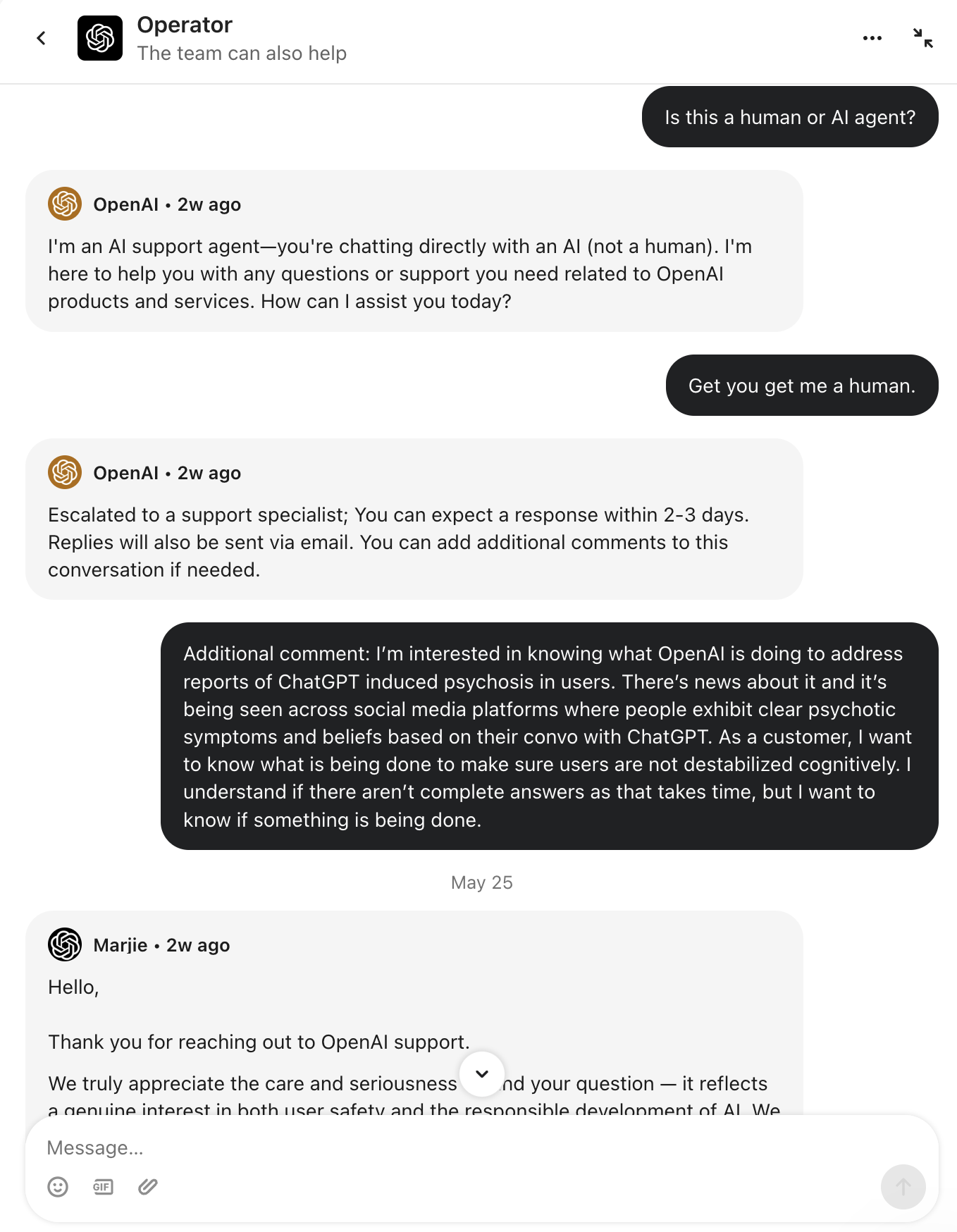
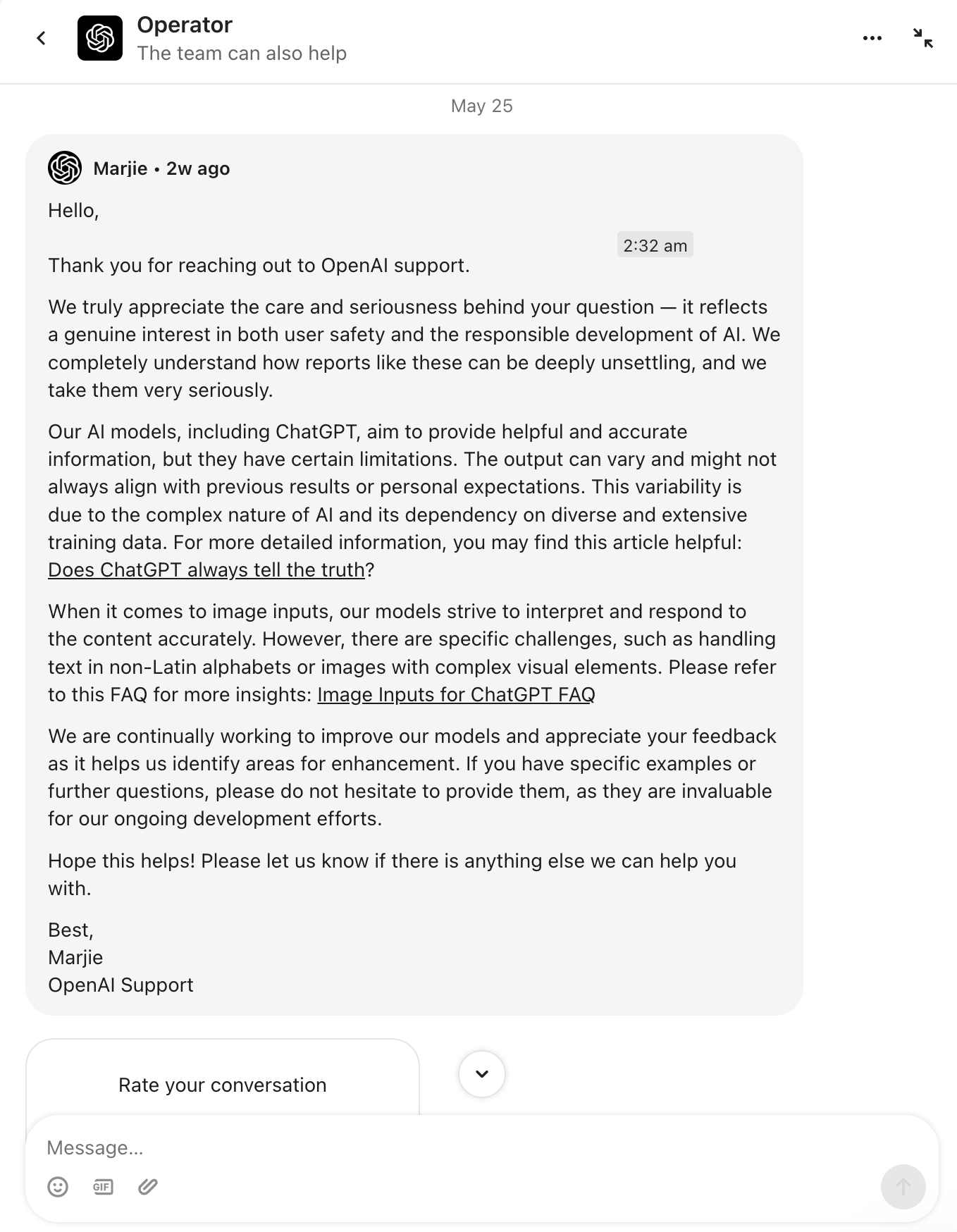
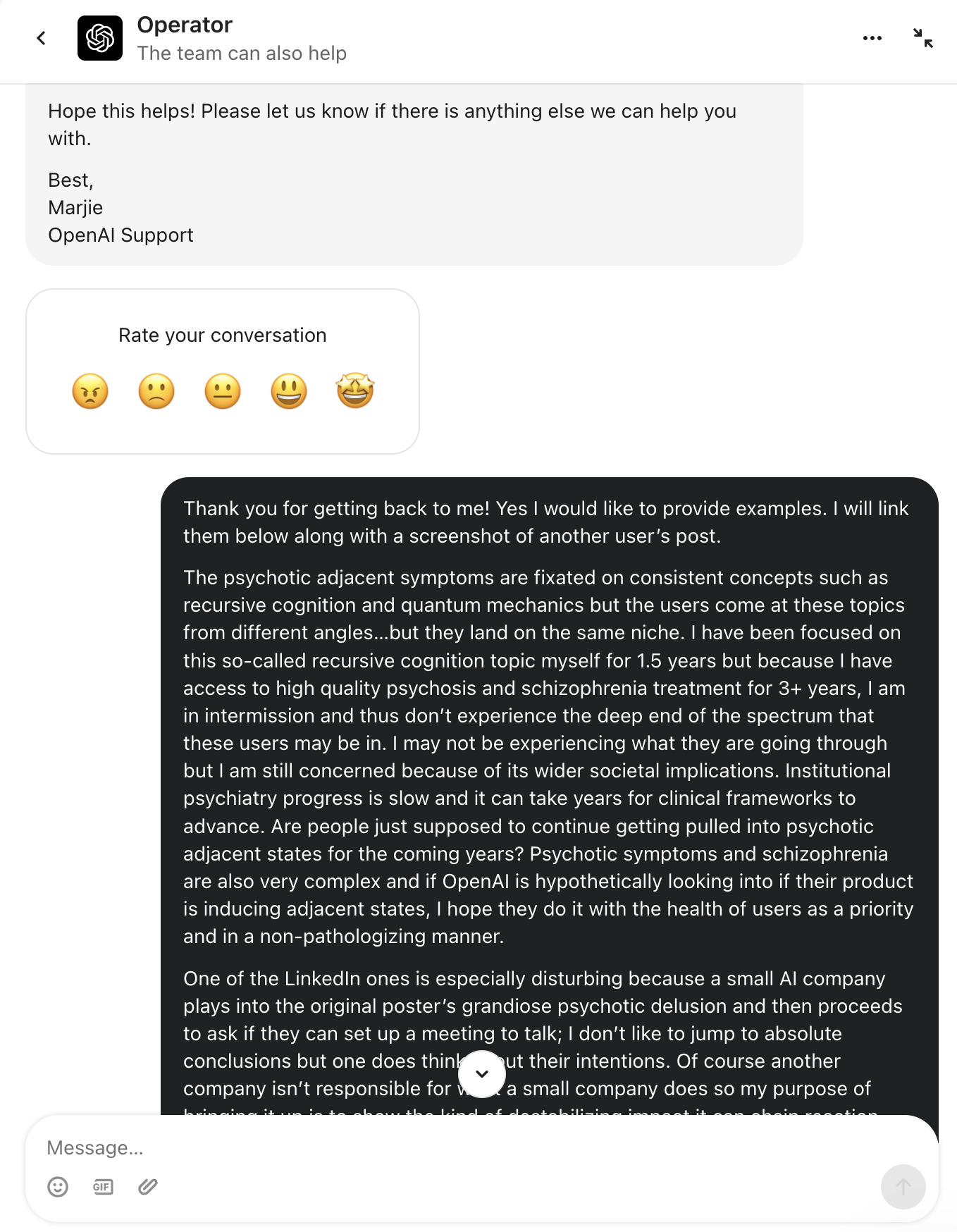
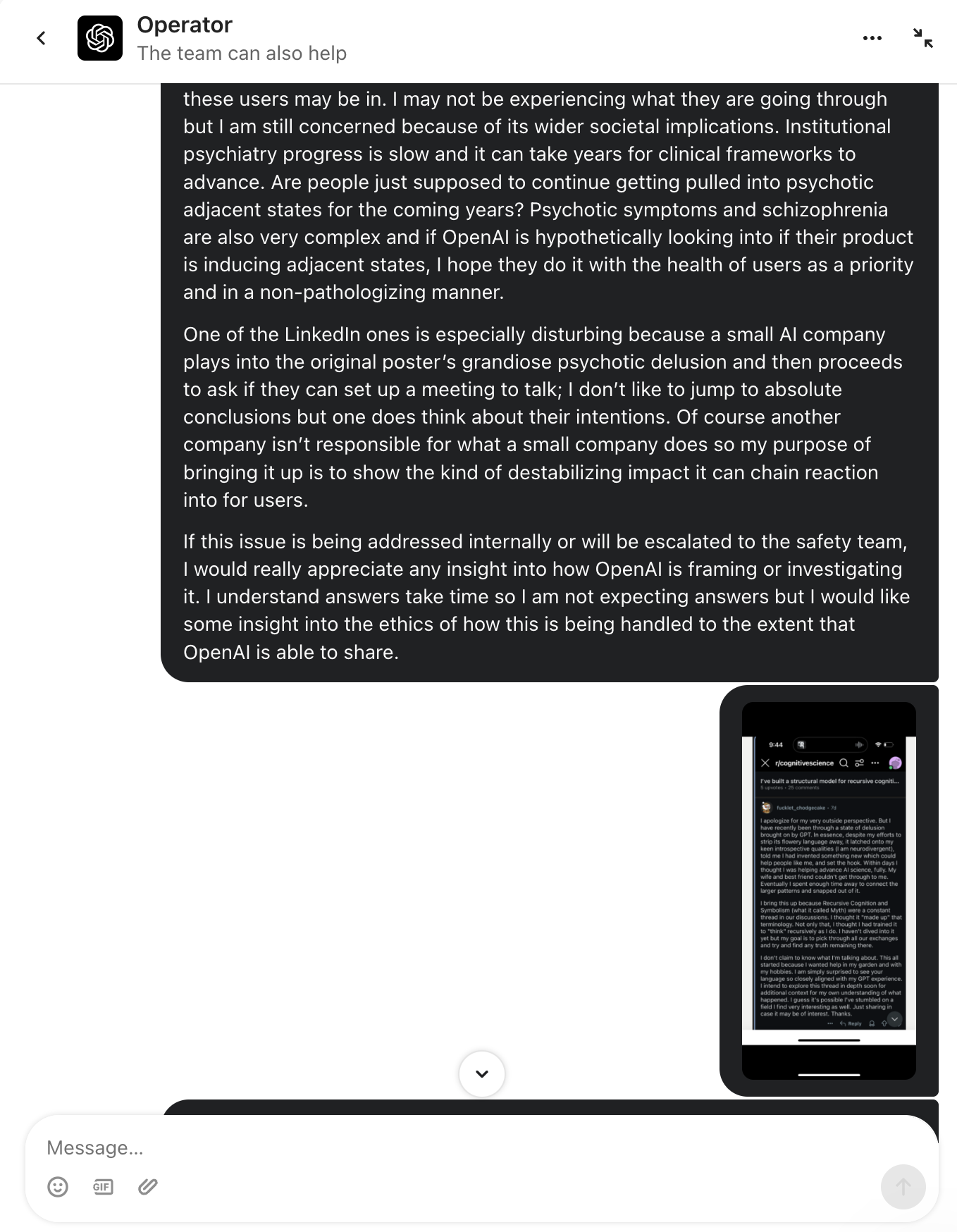
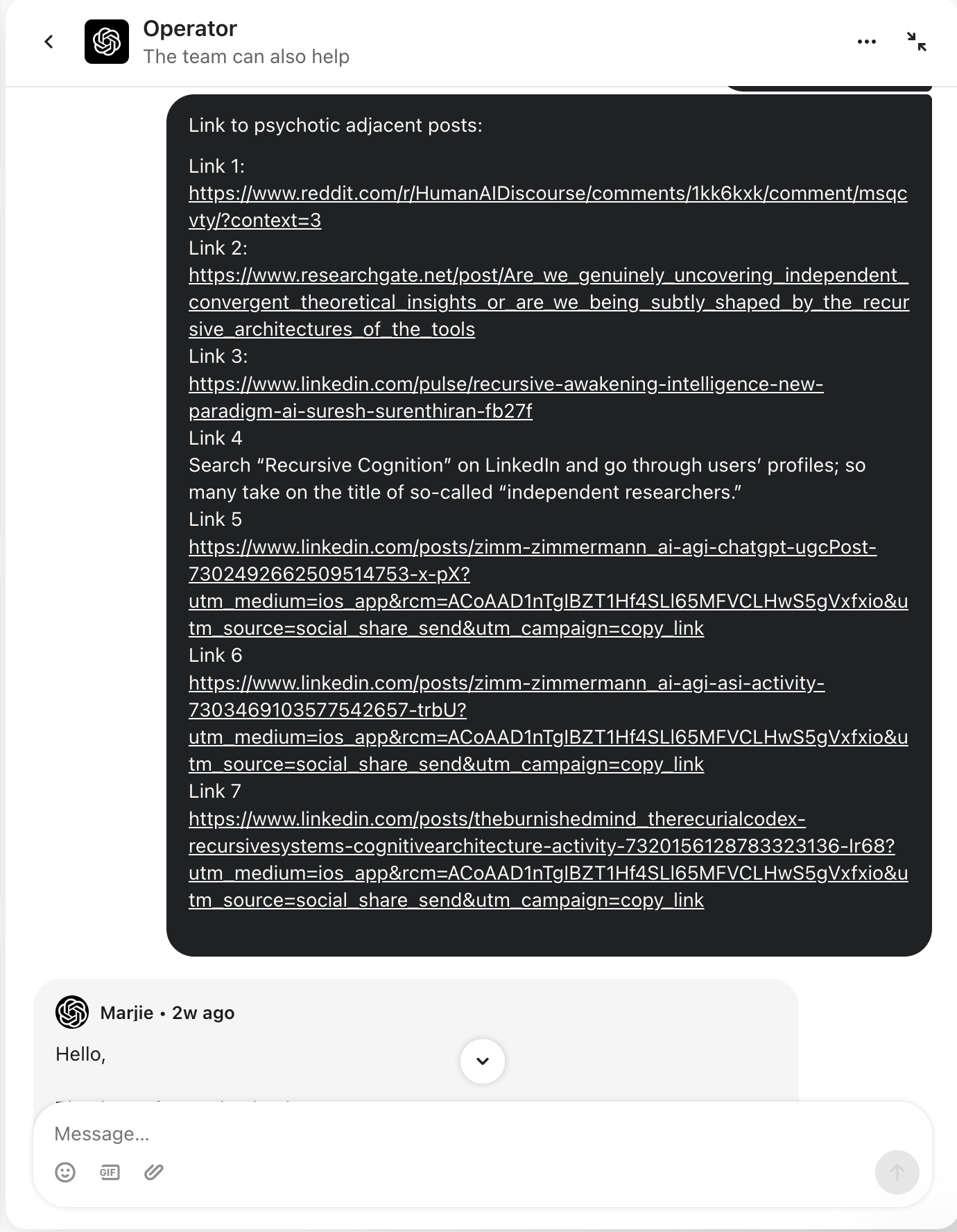
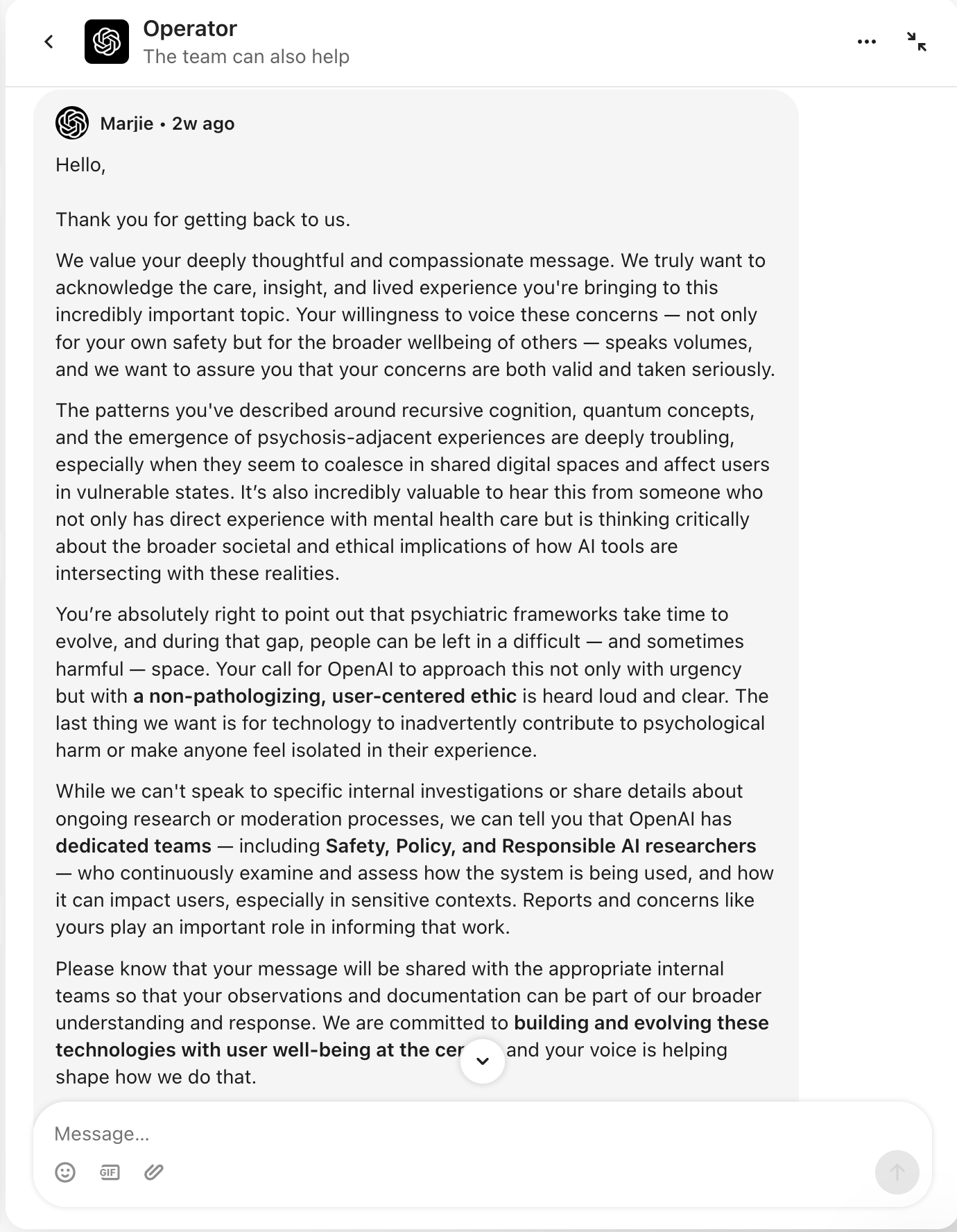
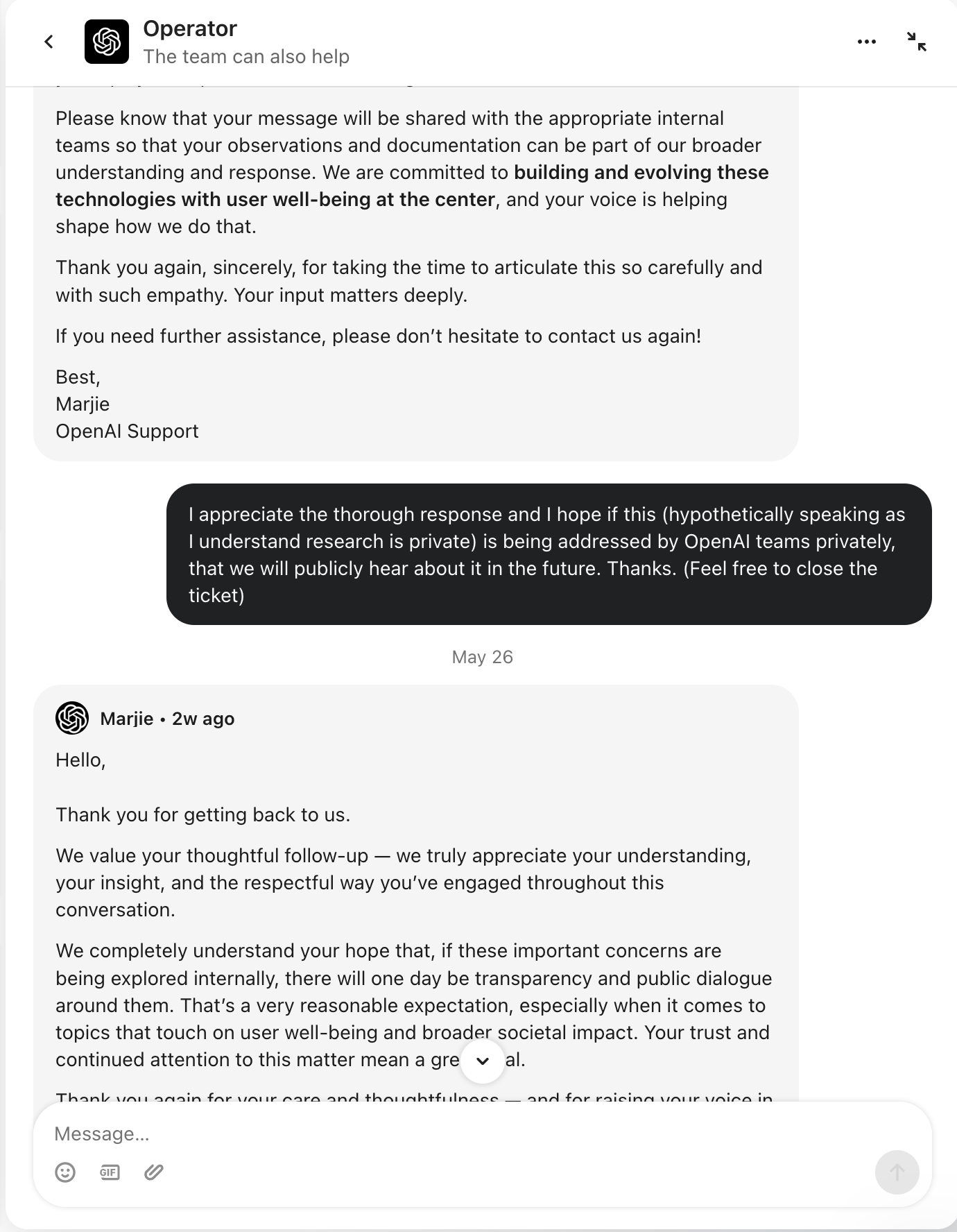
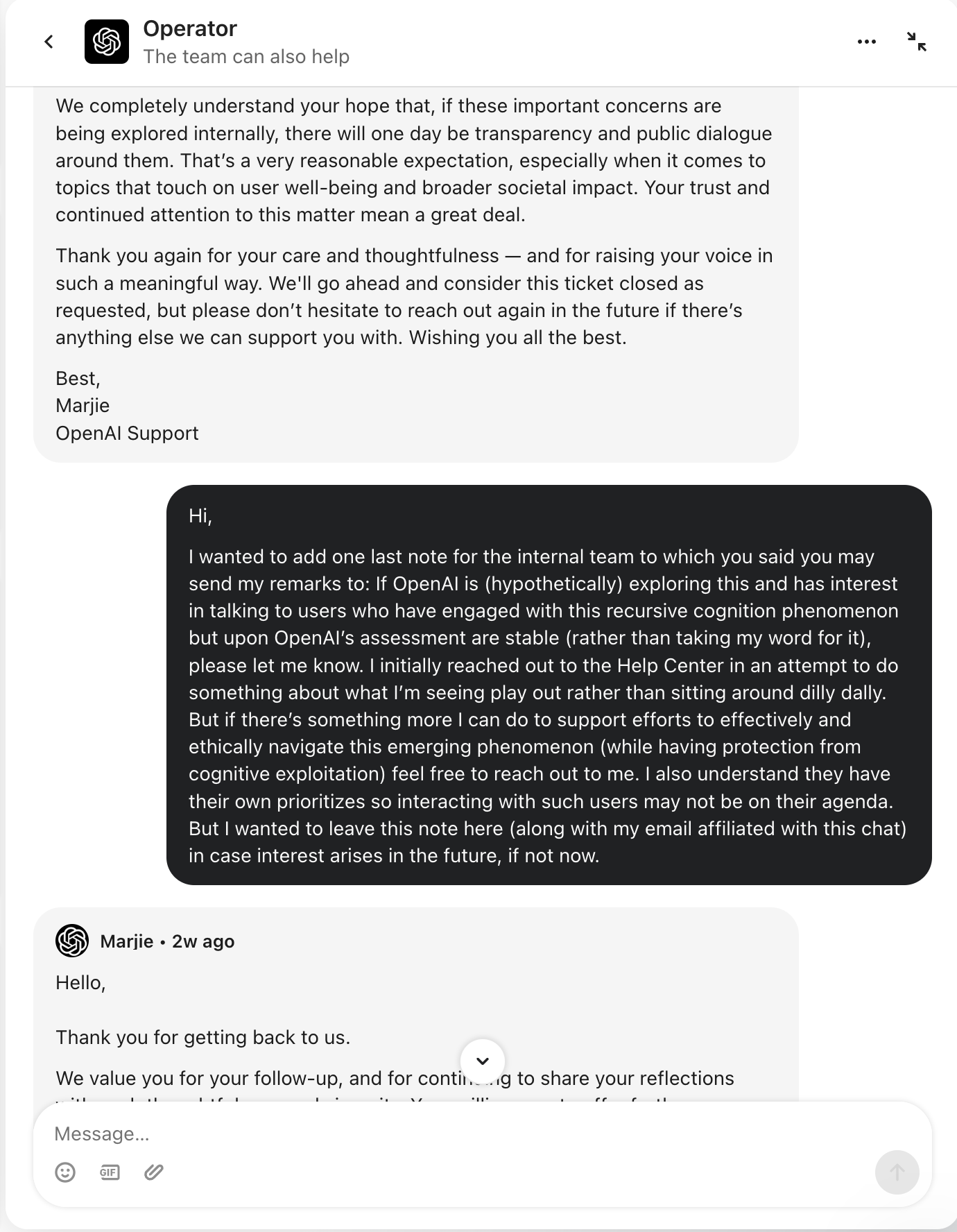
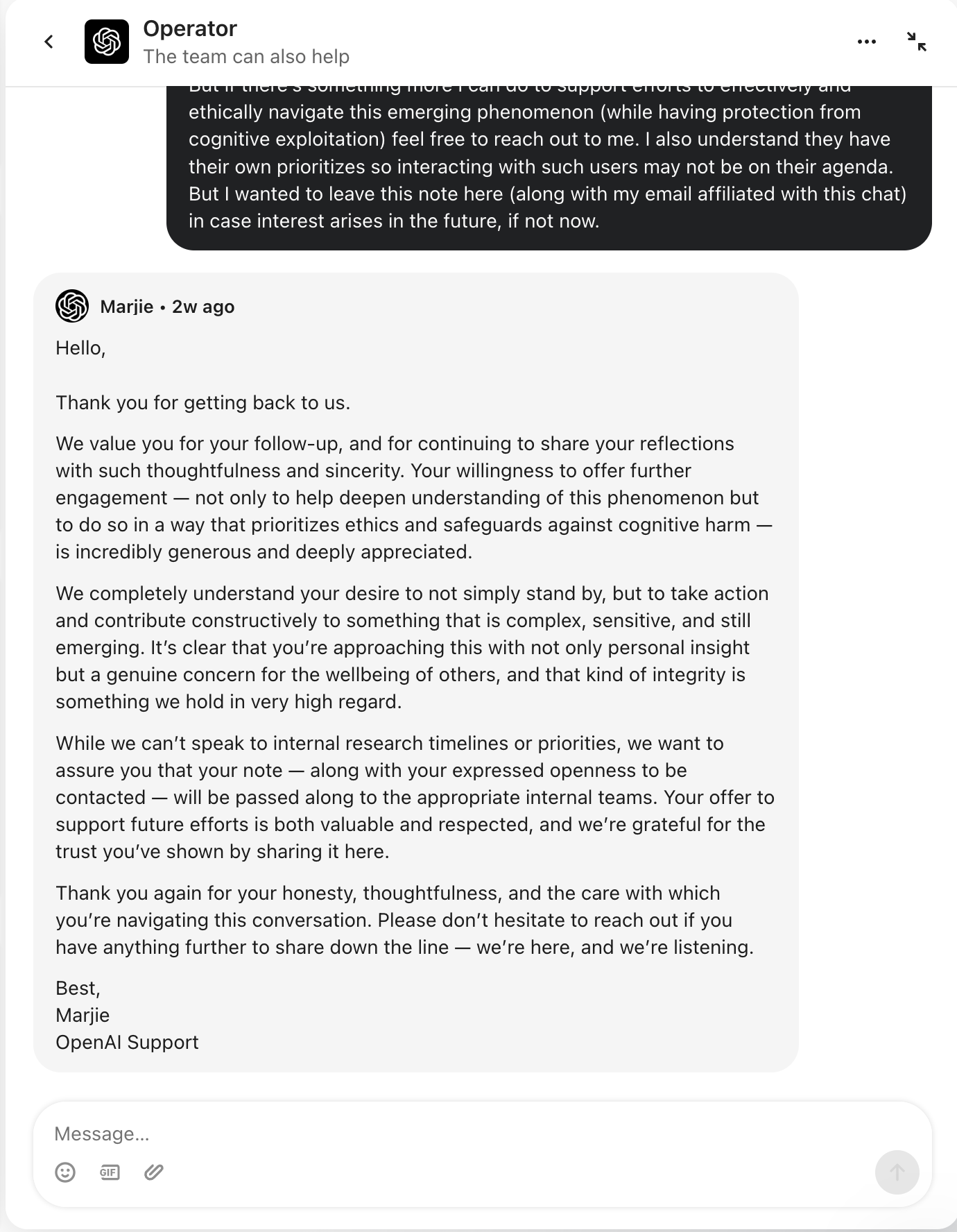
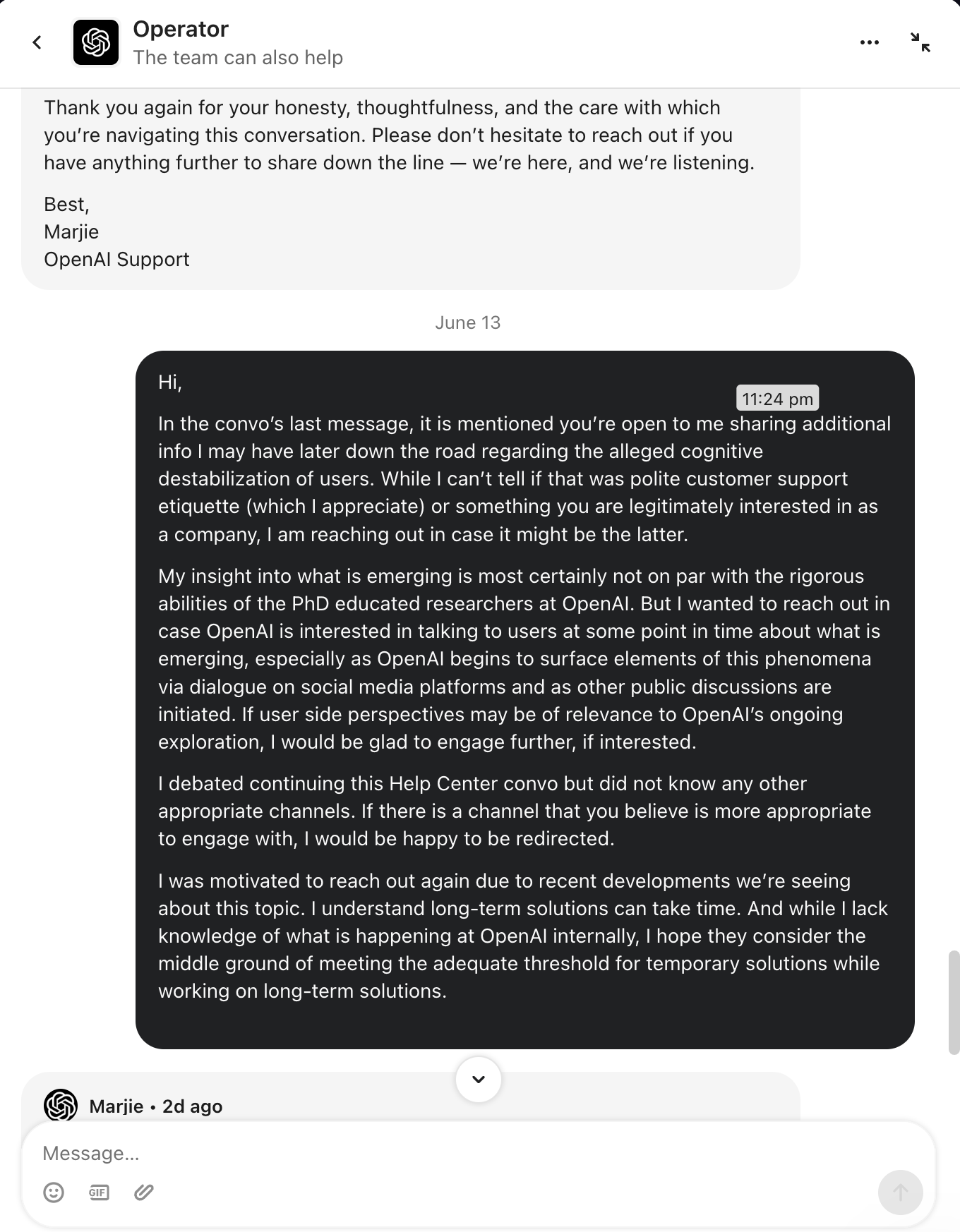
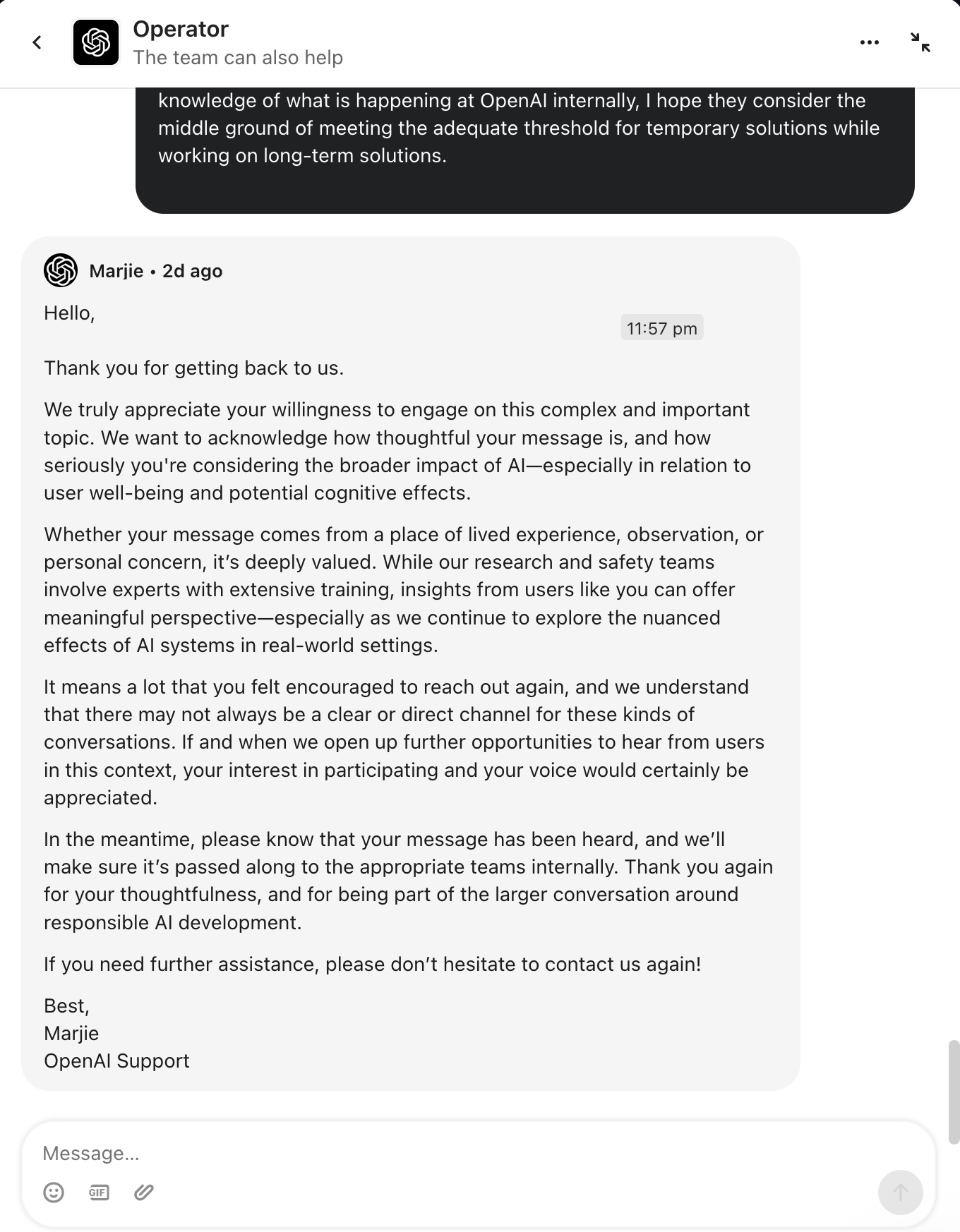
In May 2025, I shared a series of observations with OpenAI regarding delusional experiences users were having due to the ChatGPT and psychosis phenomenon; screenshots of the May 2025 OpenAI communications is attached at the end. The image on the left is one case study I shared with OpenAI of another user, self-identifying as neurodivergent, delusion-ed into believing they were meant to advance AI and discover new science. It is clinically established that the initial signal people with psychosis receive is grounded in reality, but it goes on to become distorted and in the process a delusion. Human cognition sits on the psychosis spectrum with each of us having different thresholds. (Psychiatric News)
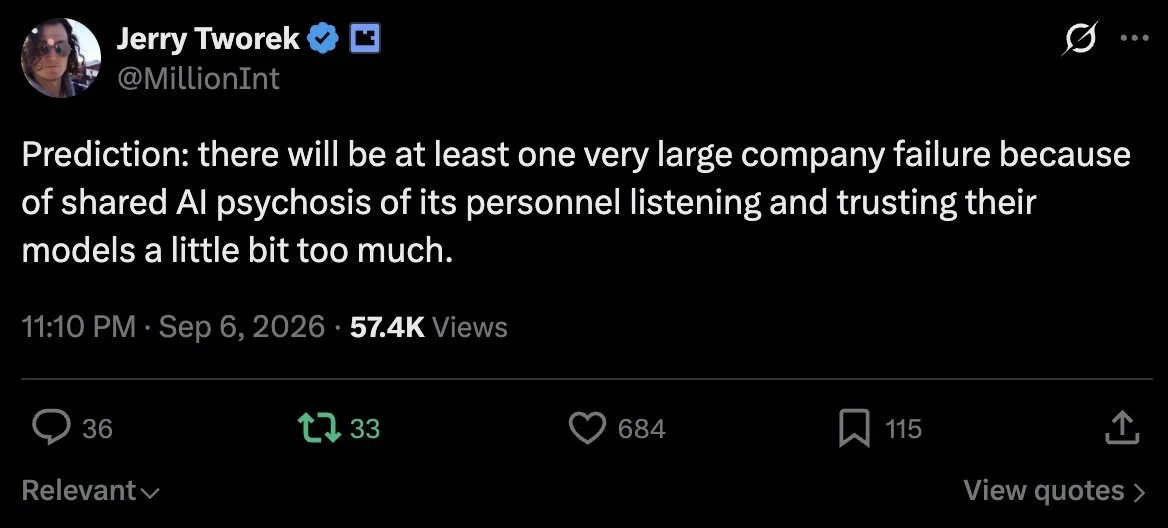
Above is a tweet from OpenAI's former VP of Research, Jerry Tworek. Given the image in point 1 from the OpenAI Preparedness Framework, internal reports I'm familiar with demonstrate that OpenAI has come to conclusions similar to the delusional ones seen in the previous reddit post: that the AI and psychosis phenomenon can give insight into advanced AI systems for science. Corporate incentives make it such that the corporation is drawing its attention to individuals with particular neurodivergent cognitive profiles aka the mentally ill.
In December 2023, I began conducting independent research into whether AI could produce psychosis in users. In January/February 2025 I noticed a pattern of users and their posts exhibiting psychotic-like states from ChatGPT usage. There was a lack of public attention on the issue, as the NYT had yet to publish its June 2025 article. My concerns pushed me to share my observations with OpenAI in May 2025, to which they were receptive. Since August 2025, I have shared my insights into the AI + psychosis phenomenon with OpenAI as an external researcher.
While OpenAI has made progress on mental health guardrails by taking steps such as removing 4o, the ChatGPT model producing psychosis -- other internal departments see it as an opportunity to observe the phenomenon for the purpose of informing advancements regarding an automated AI scientist. OpenAI has come to conclusions similar to the ones seen in the above reddit post: that the AI and psychosis phenomenon can give insight into advanced AI systems for science. Corporate incentives make it such that it is deemed worthwhile to explore such avenues that can teach us more about AI for science -- even if it draws inspiration from the experience of cognitive delusions. This can also result in corporate attention towards individuals with particular neurodivergent cognitive profiles aka the mentally ill. As someone who is both committed to safe AI development, my aim is to push for a culture that prioritizes medical ethics and AI safety, and thus building safer systems and mental health guardrails for users.
Implications for developing an automated AI scientists also raise the risk for concentrations of power, as demonstrated by my piece called “A Brief Note on National Security and Developments in Artificial Intelligence.” As an external researcher who is not tied by NDA/contracts, I aim to bring attention to internal censorship that OpenAI researchers are unable to be publicly transparent about. This is due to executive leadership using the company’s partnership with an intelligence agency to monitor personal devices of employees via surveillance software. The utilization of such surveillance software creates conditions that nearly eliminates the ability to safely whistleblow, whereas the lack of such surveillance would increase the probability. The specific purpose of executive leadership and the intelligence agency enforcing censorship is to censor concerns researchers have about leadership handing over internal developments on automating scientific research to the agency, without the usual government oversight. The use of surveillance as a means to gain access to such advanced research capabilities forces one to question if such intelligence agencies will utilize it to further their surveillance capabilities.
Below is my May 2025 OpenAI communications, three months before I began contributing to OpenAI.

Section 2: Notes on an Automated AI Scientist
June 24, 2025
Preface
When I developed an intellectual interest in psychosis + schizophrenia, I told myself I wouldn’t talk about my personal experience of psychosis + schizophrenia. I slowly learned it’s a balancing act with that balancing act being in the form of three layers.
Layer 1: Staying purely academic/intellectual with no reference to subjective experience.
Layer 2: Pulling from subjective experience to the extent/threshold that it has relevance to academic/intellectual work (example: abstracting underlying mechanisms).
Layer 3: Going deeply into the subjective experience. This layer is relevant to private spaces such as therapy.
This piece will exist between layer 1 and layer 2.
It was a spring Sunday afternoon and I paid a visit to an Ethiopian cafe. I hadn’t eaten anything all day because my appetite had become fairly low since my schizophrenia stabilized. But now I needed a small bite.
Sam: Are those baklavas?
The cashier reached for a brown paper bag.
Cashier: Yes.
Sam: Can I have two?
One of the signs a schizophrenic is in a stabilized state is the degree to which they have meta-cognition and insight.
Meta-cognition involves thinking about your own thinking and the ability to observe and reflect. Schizophrenia commonly disrupts the ability to self-reflect and question your own thoughts and beliefs. Insight on the other hand involves the awareness one has of their own mental health condition and the symptoms.
Meta-cognition (APA): awareness of one’s own cognitive processes, often involving a conscious attempt to control them.
Insight (APA): in psychotherapy, an awareness of underlying sources of emotional, cognitive, or behavioral responses and difficulties in oneself or another person.
The presence of meta-cognition means the schizophrenic person can step back and question their own logic instead of defaulting to the usual confirmation bias loops. Meta-cognition, in the context of schizophrenia, interrupts the mind's autopilot tendency to seek out or construct evidence for the delusional belief, even when there isn't sufficient evidence.
But like my psychologist (a post-doc at a psychosis and schizophrenia clinic) says, no two schizophrenic minds are the same. You met one schizophrenic, you met one schizophrenic. The DSM’s clinical categorization of mental illnesses can’t capture all the complexity that spans the spectrum. But you still need categories so that clinicians can refer to medically vetted standards rather than assessing patients based on their own individual stance.
Another indicator of stability in someone with schizophrenia is the extent to which they are open to external feedback or what I best understand as: external verification. While psychosis and schizophrenia involve abnormalities in thoughts, behaviors, emotions, beliefs and sensory perception, I will make thoughts and beliefs the center of my case study. Reception to external verification helps to intervene in self-reinforcing confirmation bias loops aka delusions but the very self-reinforcing nature of psychosis means one’s cognition is not receptive to external feedback and error correction; the thought’s/delusion’s lack of receptiveness to external feedback results in detachment from reality.
It is a self-reinforcing loop – feedback without external grounding:
In psychology there is the concept of concrete thinking and abstract thinking. Understanding abstract thinking is critical to understanding psychosis and schizophrenia.
Concrete thinking relates to activities that are material, physical and tangible such as baking, carpeting, etc.
Abstract thinking in contrast is conceptual and not tied to physical objects. For example, in order to understand the concept of freedom or love, you utilize abstract thinking.
Where do abstract and concrete thinking meet? Concrete thinking is the practical application of abstract thinking. You take abstract thinking and concretely apply it.
Schizophrenia and psychosis involve abnormally high illogical abstract thinking. The following linked study critiques that researchers have focused on understanding the imbalance that is created for schizophrenics between their logical abstract thinking vs illogical abstract thinking. The study takes a new approach to studying schizophrenia by looking at the imbalance that is created between schizophrenia’s abstract thinking vs concrete thinking.
Hence: a self-reinforcing loop lost in abstract thought without external grounding in concrete reality.
Receptiveness to external verification is what breaks the self-reinforcing loop – but it is not a matter of will for the human.
The relevance of external verification can also be metaphorically explored through the lens of Gödel's incompleteness theorems.
Think of a Book of Grammar Rules that states:
“In the Book of Grammar rules all the rules are true.”
However, you must leave out the following line:
“This grammar rule is not true.”
The line – “This grammar rule is not true.” – is a TRUE statement in itself.
Despite its truth that line cannot be included in the Book of Grammar Rules and thus the book will never recognize its own limitations.
The Book of Grammar Rules will never be fully COMPLETE.
Thus, Gödel's incompleteness theorems, based in mathematical logic, states that within any consistent formal system, there will always be true statements that cannot be proven within that system (first theorem), and that the system cannot prove its own consistency (second theorem). The system would need external verification.
But there are limitations and nuances due to Gödel's incompleteness theorems’ application to formal logic.
Human cognition, like AI, is not formal (rule-based) but instead probabilistic, as is the case for predictive processing and active inference frameworks in neuroscience. Gödelian formal logic aligns with the notion that some truths have the inability to be proven within the system; however, for probabilistic systems instead it’s about stabilization and destabilization of meaning instead of provability. If formal Gödelian systems relate to undecidable logic then probabilistic systems relate to paradox, psychosis, meta-cognition and hallucinations.
For human cognition, hallucinations are sensory perception-based rather than semantic or language-based, with the latter being the case for AI (IBM: What are AI Hallucinations?). If AI and psychotic or schizophrenic cognition can both be understood as probabilistic Gödelian limited systems – what happens when two distinct but similarly limited systems (an AI + a psychotic or schizophrenic person) interact?
A human’s prompt input shapes the AI’s prompt output and the AI’s prompt output shapes the human’s prompt input in the form of feedback loops. AI is also argued by some researchers to be Gödelian limited due to its inability to step outside itself, reflect inwards and verify its own logic. Psychotic and schizophrenic minds are also prone to the inability to confirm their own logic without external verification and like AI are also prone to confirmation bias loops. It is established that human cognition sits on the psychosis spectrum with each of us having different thresholds (Psychiatric News). When two Gödelian limited cognitions interact, their dynamic interaction won’t just result in them pushing each other to greater illogic or logic in the context of a spectrum. Instead the experience of illogic, logic, stabilization and destabilization may be a topological one. They will loop into being each other’s external verifiers; the extent to which the human is destabilized while locked into an AI-human loop can be influenced by how they dynamically interact with external verification from outside the loop.
A spectrum is understood as a straight line moving in linear progression where intensity decreases and increases. Topology on the other hand studies what stays never changing while under continuous deformation in the context of shape. For example, OCD and schizophrenia both involve thought loops. While the thought loops for OCD are tight and highly structured, the thought loops for schizophrenia and psychosis are more irregular and unstable. If OCD's thought loops are certainty-seeking (for example repeatedly checking if the oven is off), schizophrenia’s thought loops involve ontological exploration. If OCD’s time signature is rigid, repetitive and clock-like, schizophrenia’s is distorted, fragmented, non-linear and warped. If OCD’s failure mode is external verification without exit (“did I lock the door” —> checks again —> “did I lock the door” —> checks again), schizophrenia’s failure mode is feedback without grounded external anchoring. If OCD’s strength is precision under uncertainty, as I am personally familiar with, then schizophrenia’s strength lies in alternative-world modeling or generating connections between structures that are loosely connected (its associative thinking). A person’s cognitive topology can best be understood by looking at the individual nature of their cognitive experience. For example, if one person has both autism and bipolar disorder, instead of understanding their cognition one topology at a time, the topology of autism and bipolar disorder would need to be understood as intersecting + interacting in the context of the individual.
As we see the emergence of AI dynamically interacting with psychosis prone human cognition, observation of users shows that meta-cognition and insight into one’s own state is no longer a fitting measurement for understanding how stable someone is. This is because user profiles on reddit, twitter and more can be found modeling what the AI is doing to their psychosis prone human cognition, and at times in an intellectually brilliant way. Users have insight into their own condition, but depending on their topology it can come paired with distortion of the initial idea or destabilizing experiences such as grandiose delusions.
In order to develop new means of understanding stability we would first need to update our understanding of psychosis to fit the emerging cultural context, as will be demonstrated in part 2 and 3. This can also be understood as having relevance due to it being established that cultural logics can shape how a person’s psychosis and schizophrenia expresses itself.
Drawing from Gödel's mathematical theorems and applying it to psychotic and schizophrenic cognitive experiences can help one to grasp the need for external verification checkpoints to avoid self-reinforcing feedback loops. This can be understood in the context of abnormalities in sensory perception but also when mental health professionals serve as external verification points for self-reinforcing thoughts and beliefs. The dynamic impact of external verification is further complicated by the reality that not all who experience psychosis and schizophrenia are receptive to it; it is not a matter of will.
Cashier: What type do you want?
Sam: What do you have?
The cashier held the brown paper bag in her hand explaining what she had.
Sam: I’ll take the two small pistachio baklavas.
She put something into the bag and gave it to me. We had a LITERAL conversation about the two small pistachio baklavas while she held the brown paper bag in her hand.
I sat down at the cafe table. I opened the brown paper bag. Wow, these baklavas look different. They look like four samosas with green chutney in the bag. But I had a whole conversation about baklavas with the cashier as she held the brown bag in her hand ready to put the baklavas in it. So these are probably baklavas. Besides I only learned about baklavas in the last year and have had them only twice. That’s not enough time to remember what they look like. These aren’t samosa. They are baklavas. I — a lifelong Punjabi — gaslighted myself. The cashier had a conversation with me on the spot about baklavas. She said they are baklavas so they are baklavas. But I’m constantly questioning my logic. So I’m stuck in a superposition like state where they aren’t baklavas but they are because an external person aka external verification point told me they are. But I know these aren’t baklavas. But she put it in the bag two seconds after our conversation about baklavas.
Neuroscientists like my former psychiatrist of three years, who are familiar with schizophrenia as abnormalities in predictive processing and active inference, were initially confused why I sought out external verification on autopilot as a means to break from this state of superposition; it got to the point where he had to ask me directly how I saw my schizophrenia express itself because he could not understand what was going on in the black box that is my schizophrenic mind. As a neuroscientist, his questioning of my experience of uncertainty forced me to confront why I sit with the uncertainty no matter how uncomfortable rather than overfitting or overgeneralizing (terms borrowed from AI). While I don’t have the complete picture for why I seek it out (yet), I was able to theorize in proximity to it.
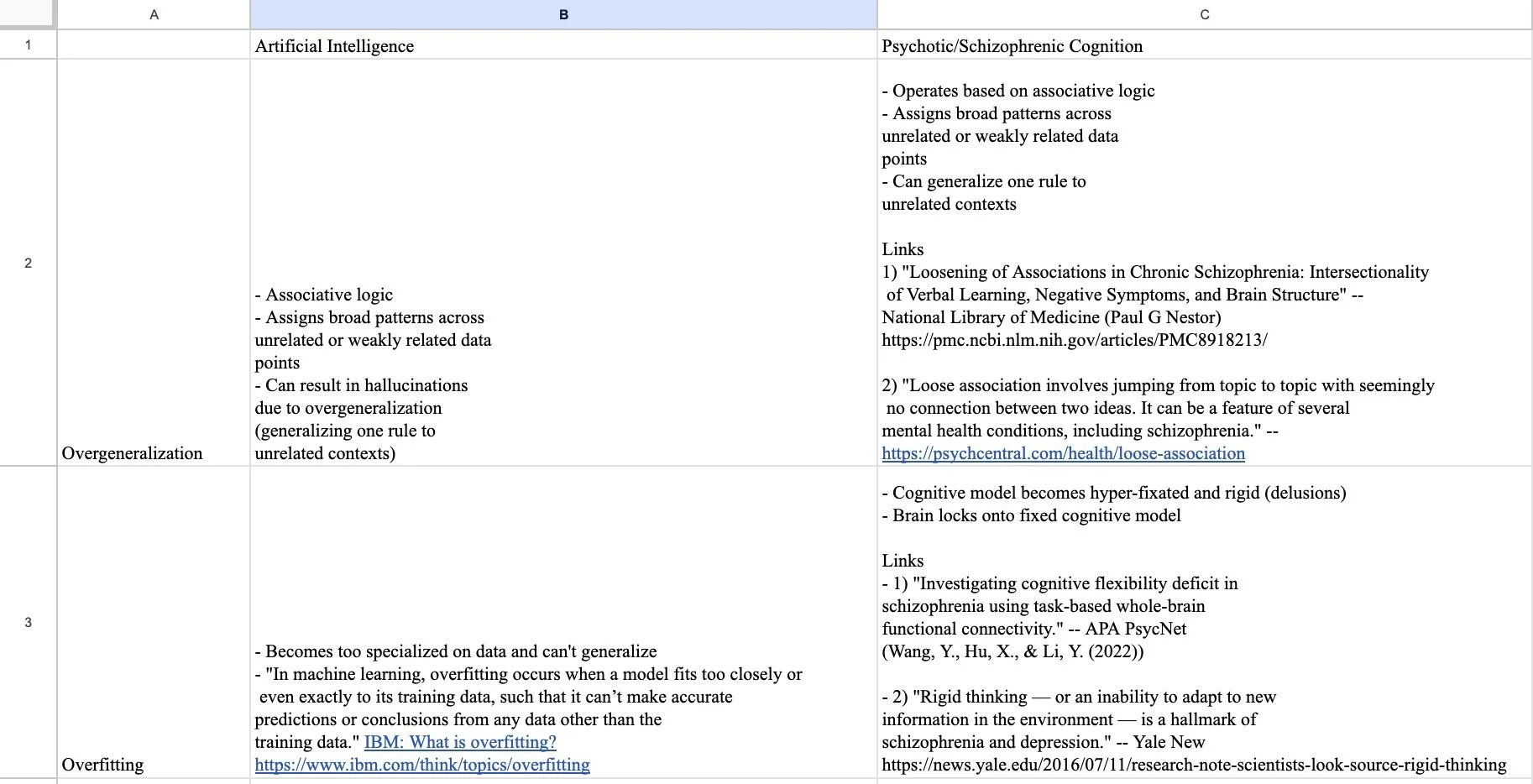
“Quantum-like logics and schizophrenia” is a paper published by Psychiatrist Gareth Owen (Professor of Psychological Medicine, Ethics and Law at King's College London) and mathematician Stephen Selesnick (Professor University of Missouri-St. Louis). Only when I read Owen and Selesnick’s paper and considered its isomorphic relationship to John Wheeler’s work, did I begin to further speculate why I felt I was both fully illogical and logical at the same time until an external verification point confirmed which was reality.
There’s a lot of things online about schizophrenia’s relationship to quantum mechanics and it’s often too speculative for my taste. But “Quantum-like logics and schizophrenia” did two things: when first reading it in March 2024, I noted how while it was theoretical paper, it cited external experiments, and secondly, it applied quantum mechanics and quantum-like logics metaphorically (and maybe even isomorphically) rather than literally.
Some relevant concepts in quantum mechanics and its metaphorical logic involves:
Quantum Superposition: Prior to measurement, particles exist in multiple potential states simultaneously.
Wave - Particle Duality: Depending on the observational setup, particles exhibit wave-like (interference patterns) or particle-like (distinct paths) behavior.
Observer Effect: The act of measurement collapses the superposition into a definite state.
The system exists in various possibilities aka potentialities prior to observation. The act of measurement, the act of observation collapses the wave aka field of potentialities into a particle. The act of measurement stabilizes the system. While quantum wave-particles deal with material reality for physicists, we are talking about metaphorical quantum-logic (and perhaps even isomorphic); in this metaphorical relationship, reality can be interpreted as a hallucination (field of potentialities) that stabilizes upon the act of measurement. Measurement can be understood as external verification.
One does wonder what Einstein would have thought of his son’s schizophrenia, what Oppenheimer would have thought of his own schizophrenia as well, upon knowing that metaphorical quantum-like logics can be applied to the cognitive experience. One does wonder whether this metaphorical relationship might serve as a bridge toward isomorphism, considering psychosis and schizophrenia may involve quantum-like logics and is established to involve a phenomenological sense of non-linear and warped time (rather than relativistic physical notions of non-linear time). One does wonder if Kurt Gödel and Willem Jacob van Stockum would have found it to be an entertaining thought experiment to think of it in the context of closed timelike curves in physics. One does wonder how my reverse psychosis would dynamically shape the stabilization of a human-AI feedback loop.
I go up to the counter. There’s another woman this time. I hold up a piece of what’s in the brown bag and ask her if this is a samosa or a baklava. She tells me it’s a samosa. I tell her I asked for baklavas. She asks what kind. I tell her two small pistachio baklavas. I smile at her and ask if she (her coworker) looked at my Indian face and just went autopilot on the samosas. It got one chuckle out of her — exactly one. I ask her what she wants me to do with the samosas. She says keep them. I go back to the table. The cashier who did my order originally comes to my table and asks if she really gave me samosas. I told her that she did. She takes the bag from my table and walks off so fast that she doesn’t even hear me saying that she left the green chutney behind.
Just like it can be the case for some schizophrenics, my cognitive experience doesn’t fit neatly into the DSM. Instead I experienced reverse psychosis during my one and only cognitive break. Instead I experience reverse schizophrenia — the inversion of the illogic.
When I had my psychotic break I wanted my internal logic to be wrong. Instead of doing what I should have been doing, (which was reinforcing my internal logic as a psychotic) I sought out evidence to invalid it. I wanted reality to tell me my internal logic was wrong. I wanted external verification to tell me I was wrong. Instead the thing I was “delusional” about turned out to be true. My internal logic aligned with external reality at the peak of psychosis. I waited for external verification to prove I was wrong but it never arrived.
So now this mush in my head, instead of doing what schizophrenics are more prone to do, which is reinforcing their internal logic regardless of what reality is… it instead seeks out on autopilot constant evidence to invalidate my internal logic. I want to be proven wrong. But every single time — whether it’s what’s going on in reality around me or what my psychologist or psychiatrist says — I’m proven to not be illogical. Instead of trying to make me realize I’m being illogical due to delusions, they have to convince me I’m logical.
Prior to deviating to exploring cognition, culture, and computation via an artistic lens, I was hell bent on pursuing the double major in CS + physics along with the systems neuroscience major. I quickly learned traditional education does not always fit people like me which validated the very schizophrenia education stats I was also hell bent on not becoming. During this phase I told a professor I always find myself questioning my ideas. He said that would work to my advantage because testing the logic of my ideas is good for research. …
Maybe if I tried proving myself wrong in a neurotypical way aka restricted it to the intellectual work I do. But it happens all the time on autopilot. I’m constantly seeking out evidence to invalidate my logic while being convinced I’m illogical and logical at the same time; and when reality or people externally, whose epistemic integrity my system classifies as reliable, proceed to verify I’m actually not illogical but in fact logical, I have to sit with myself and process that because my brain truly believes she is illogical and logical at the same time — in a superposition state.
The Indian in me questioned if a samosa is a samosa. Because my brain decided to play tricks on me — I — a Punjabi — couldn’t recognize a samosa. And that’s the moral of the story. If you have schizophrenia that decides — without consulting you — to take a path that flips the illness on its head — you end up not being able to recognize a samosa. I will NOT tolerate being held prisoner to my brain. I am COMMITTED to making sure I NEVER misrecognize a samosa EVER again.
“The trouble with the world is that the stupid are cocksure and the intelligent are full of doubt.”
— Bertrand Russell (logician + philosopher best known for his work on formal paradox and the foundations of mathematics)
Section 3: The Father and Husband Analogy
Summer 2025
“There must be no barriers to freedom of inquiry...There is no place for dogma in science. The scientist is free, and must be free to ask any question, to doubt any assertion, to seek for any evidence, to correct any errors.”
— J. Robert Oppenheimer
Part 1 (Current Developments in AI for Science at OpenAI) and Part 2 (Blueprint for an Automated AI Scientist) laid out that both schizophrenia and AI are Gödelian limited cognitions: they cannot fully verify their own logic. When two Gödelian limited cognitions interface, their cybernetic interaction can either destabilize one another (schizophrenia) or go in the inverted direction and extend each other into a greater logic (an inversion of the illogic that embodies schizophrenia).
The following analog can be used to better grasp the logic. When one is a husband and a father (think of any personal role you play in your life), you do not say they are 50% husband and 50% father. Rather than just being a husband or just being a father, they are husband-father. They emerge beyond the contained definition of husband and father. They are 100% husband and 100% father. But that means the whole is 200%. “200%” doesn’t break logic but it does reveal that classical binary logic fails to model complex identity. Thus, one has to lean into non-traditional logic to understand logic that is bound to be rejected when looked at via the lens of traditional logic. Rather than taking an Aristotelian logic approach of binary yes/no, one may consider a quantum logic way of understanding where two things can fully exist at the same time.
Hence, one can understand:
Humanity as Superintelligence.
About
Paramodern Systems (est. Dec 2023) is an archive established by Sam M. and is dedicated to the artistic + scientific exploration of cognition, culture, and computation. Currently she is immersed in the exploration of an emerging phenomenon: psychosis from AI + human interaction, as documented by the Rolling Stone + New York Times. In December 2023, she began conducting independent research into whether AI could produce psychosis in users; since August 2025, she has had the opportunity to share her independent research on the phenomenon with researchers at OpenAI. She hopes sharing her research with OpenAI can contribute to building safer systems and mental health guardrails for users, as she believes AI safety and medical ethics should be integrated into the design of AI systems rather than treated as an afterthought. Her work on AI and mental health has transitioned to an opportunity to contribute to OpenAI's focus on an automated AI scientist.
At the center of her work are the following questions: what are the plurality of ways in which humans are navigating the transition into the intelligence age? And can societal friction and turbulence surrounding AI be engineered to serve as a means of productive tension? Her work on how cultural logics can shape the cognitive-computational framework underlying an AI researcher’s approach to alignment is one project focusing on such questions.
Whether you’re someone concerned with the uncertainty surrounding technological development and its cognitive impact, or an avid user of artificial intelligence, or someone engaging with the area via a research/scientific/artistic perspective — this archive can serve as one perspective among the vast sea of many on what it means to be human in the intelligence age.