Notes on Metamodernism: The Cultural Lineage of My Cognition
An Exploration of Cognition, Culture and Propaganda
Part 2
Sam Mann
Notes
Note 1: Meta-cognition as Understood Through the Lens of Ideological Propaganda
Note 2: Schizophrenic Metacognition’s Application to Meta-Politics
Note 3: A History of Cognitive Engineering
Note 1: Meta-cognition as Understood Through the Lens of Ideological Propaganda
There must be no barriers to freedom of inquiry...There is no place for dogma in science. The scientist is free, and must be free to ask any question, to doubt any assertion, to seek for any evidence, to correct any errors.
— J. Robert Oppenheimer
Capitalists and marxists often level the same attack on each other — that attack being that the opposing side is propagandized. This is often done without addressing if their own side is too propagandized. One of the influences of propaganda can include the dismantling of critical thinking skills. I believe that most capitalists and marxists have a tendency to develop their belief system via propagandization. But there is a sector from both camps that actually do pick up a book and engage with the various ideological frameworks with an open-mind and via critical thinking skills although I do believe it is rare.
In order to counter the impacts of propaganda one needs to both put their preconceived notions and subjective experience aside while learning about various ideologies AND eventually bring in their own subjective experience as leverage to inform their worldview. The following is the theoretical foundation for this argument. Modernism (1890s/1900s - 1940s) embraced objectivity, reason and logic while the cultural movement following it, Postmodernism (1950s/1960s - 1990s), had ideals of subjectivity, uncertainty and ambiguity. I argue that one should refrain from embracing Modernist notions BUT nor should Postmodernist notions unequivocally be embraced; this is because we have emerged into our current era of Metamodernism (2000s - Present). Cultural movements transition from one to the next by reacting in direct opposition to some aspects of the previous cultural movement while carrying on other elements of that same movement instead of reacting in reaction to it. Basically, they function according to contradictions. Thus our current times are both a product of both Modernism and Postmodernism; Metamodernism oscillates between Modernism’s notion of logic and reason + Postmodernism’s ideals of uncertainty and subjectivity.
Thus, this is the theoretical foundation for why one needs to both put their preconceived notions and subjective experience aside while learning about various ideologies – or what Modernism would frame as objectivity – AND eventually bring their own subjective experience in as leverage to inform their worldview – what Postmodernism would frame as relativism. This can allow one to assess both opposing and nuanced arguments, along with their own arguments for all its dimensions. I think one of the elements both sides fail to recognize is that politics at the end of the day are subjective. Two people can read the exact same books and look at the exact same resources on ideological frameworks via the lens of critical thinking skills and still come to two different conclusions and interpretations due to politics being subjective — but at least it will be views that are the product of educated conclusions.
The issue becomes that the majority of society does not attempt to engage with ideological frameworks via the lens of critical thinking skills. For this reason, I reject the premise of both sides accusing each other of being propagandized as it does not take a bird’s eye view (or a meta view) of the bigger picture. I think if we lived in a society that attempted to let people develop their ideological frameworks via critical thinking skills combined with subjective experience rather than attempting to sway them to one’s side, individuals in society would have greater satisfaction with themselves as their own ideological frameworks would be the organic deduction of what their education and subjective experience naturally/authentically led them to.
When American society is breaking at the seams due to political polarization and broader society continues facing unprecedented issues – from AI to the climate crisis – the issue of “why” is bound to surface. The question isn’t why our society is breaking at the seams. The question is why our current set of tools isn’t enough to address the challenges? Aspects of the answer to this question sit with recognizing that our current society is running on outdated logic. The challenges we face are beyond our current logic and are instead better understood via the lens of the emerging logic of Metamodernism. As we continue running on outdated logic, the transition into Metamodernist logic becomes one that is a slow burn.
Note 2: Schizophrenic Metacognition’s Application to Meta-Politics
Philosophy + psychosis have more in common than many people...might care to admit. ...each is governed by very strict rules. The trick is to discover what those rules are, + in both cases, that inquiry takes place almost solely inside one’s head.
— Elyn Saks
Schizophrenia is much more complicated than what broader general society understands it as and I believe it’s in part due to what my psychologist once told me: you meet one schizophrenic, you meet one schizophrenic. No two schizophrenics experience the condition the same way due to it being (what clinicians call) a spectrum. That isn’t exactly easy to classify/categorize in the DSM unfortunately. Thus, this is one schizophrenic’s perspective.
Schizophrenics can have black + white reasoning AND also reasoning that is overly patterned + nuanced, when there aren’t any nuances/patterns.
Examples (not personal, but commonly cited):
Black + White Thinking: “I’m either chosen for a purpose (grandiose delusion) or I’m being targeted/surveilled to be destroyed (paranoia).”
Overly Nuanced + Patterned: Making delusional connections between unrelated things due to perceived patterns between them (associative thinking).
It might sound paradoxical — well that’s because it is. My schizophrenia manifests as political delusions and it has taught me this form of cognition is the embodiment of paradox. The paradox of both of those modes of thinking existing within me at the same time resulted in my politics to be either very black and white. Or it went in the opposite direction where I saw politics in an overly patterned and nuanced manner. I used past tense because prior to years of treatment it used to be an either/or situation where I would swing one way or the other (black + white OR nuanced + patterned). Therapy + medication has assisted me in integrating these modes of thinking to become more logical in a meta way. I know from experience people can be understandably skeptical of schizophrenics when they — well…say anything.
For example, people may be skeptical of me claiming I’m logical despite being a schizophrenic whose illness centers around political delusions. Laying out my take on the influence of propaganda on capitalists + marxists demonstrates my logic despite the nature of my schizophrenia. This is because schizophrenia alters the way one self-reflects thus having insight/self-awareness/meta-thinking into your own logic (or rather illogic) is a positive. Thus the logical deduction is that a schizophrenic whose illness centers around political delusions would have more integrated logic if they demonstrate meta-cognition — in my case a meta-level understanding of politics.
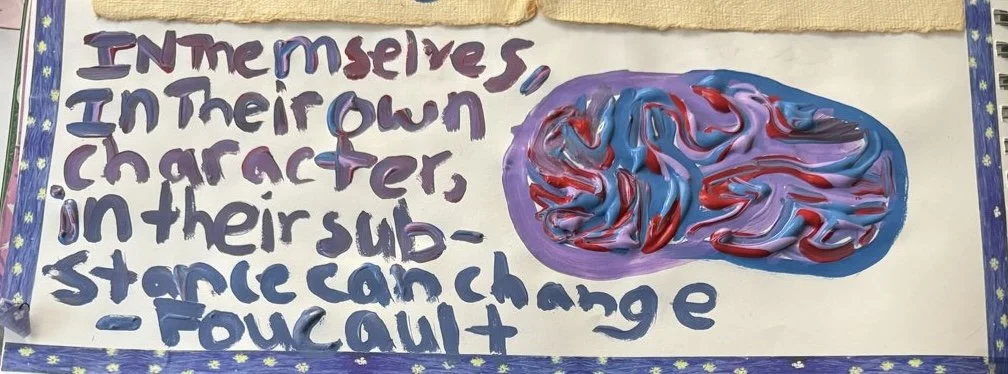
Imagine a photograph representing a face. If you make this image go from positive to negative, in a way all the dots of the picture are going to be modified. That is to say that all the points that were white will become black and that all the points that were black will become white. None of the points, none of the elements therefore remain identical. And yet you can recognze the face. And yet the face remains the same even though it has gone from positive to negative, and you can say that it stays the same; you recognize it because the relations between all these different elements have remained the same. Relations between the points have stayed the same, or the relations of contrast + of opposition between white + black have remained the same, even though each of the dot that was white has become black + each point that was black has become white. Deep down, in a very broad sense of what structuralism is, we can say that structuralism is the method of analysis that consists of drawing constant relations from elements that in themselves, in their own character, in their substance... can change.
— Foucault
Note 3: A History of Cognitive Engineering
Over the past decade Sam’s cognition has gone on a trajectory that is isomorphic to the structure of cultural movements. When Modernism put its faith in reason and truth – teenage Sam sat in her IB (International Baccalaureate) English class, centered on Modernist literature, unknowingly lacing psychoanalytic writing exercises with appreciation for her logic. Perhaps she had a little too much appreciation – a little too much confidence in her logic so much so the scale tipped towards disorientation – from the conscious to the unconscious. The mode of thinking she once prided herself on fragmented at the seams; the confidence in her politics – fractured by the consuming feeling of anxiety/neurosis. It was during late Modernism, when society in its own way began tearing at the seams. The Great Depression. The World Wars. Atomic Warfare. Global Decolonization. The societal anxiety/neurosis that literary theorists noted of such times led to a state that parallels acute psychosis — the state often experienced before one is cognitively diagnosed with schizophrenia. It was Sigmund Freud who argued that the unconscious was inaccessible to humans and that schizophrenia was an illness of the consciousness. Freud also founded psychoanalytic theory during the Modernist era and it is Routledge’s Postmodern Impulse which argues, “…psychoanalytic theory and practice – which discloses 'the interminable falsity of the human subject's belief in the mastery of its own mental life' – is in part responsible for the coming of the postmodern era." Following late Modernism’s acute psychosis, writers of the 1960s explored fragmentation and non-linearity as literary theorists made salient that which had surfaced was Postmodernism’s “consciousness of schizophrenia.” Instability leading to disorientation. Contradictions leading to disintegration. Pride replaced with skepticism. Such was the unrecognizable mind she was left with. It took one Google search to realize this mode of thinking wasn’t a temporary condition – it would be lifelong. Observing this person from afar, who was she if she could never return to her former logical mode of thought? But perhaps that was the point. Perhaps the point wasn’t to return to what was before. Perhaps the point was to integrate into something more. Postmodernism's “consciousness of schizophrenia” with its state of disequilibrium and fragmentation emerged into greater equilibrium during the next cultural era of Metamodernism. As her mind quietly wandered lost in this political terrain – that same disorientation went beyond a form of logic that the psychotic version her couldn’t have imagined – a meta logic of politics. And as I sit with the cultural lineage of my cognition – my thoughts – I am reminded that schizophrenia is a logic that is part of the human design...an initiation of becoming that is very much human. And maybe even machine.
We had the experience but missed the meaning,
And approach to the meaning restores the experience
In a different form, beyond any meaning
We can assign to happiness. I have said before
That the past experience revived in the meaning
Is not the experience of one life only
But of many generations — not forgetting
Something that is probably quite ineffable:
The backward look behind the assurance
Of recorded history, the backward half-look
Over the shoulder, towards the primitive terror.
— T.S. ELiot








About
Paramodern Systems (est. March 2023) is an archive established by Sam M. and is dedicated to the artistic + scientific exploration of cognition, culture, and computation. The archive serves as a time capsule to document the evolution of both her ideas and skills. Her more specific interests include psychosis, AI safety, AI + mental health, and the cultural movement of Modernism. She is currently studying film as an undergraduate with a focus on new media technologies.
At the center of her work are the following questions: what are the plurality of ways in which humans are navigating the transition into the intelligence age? And can societal friction and turbulence surrounding AI be engineered to serve as a means of productive tension? Her work on how cultural logics can shape the cognitive-computational framework underlying an AI researcher’s approach to alignment is one project focusing on such questions (link).
In addition to these area of inquiry, she is examining the phenomenon of AI and psychosis, as reported by the New York Times. Her lived experience with psychosis and schizophrenia equips her to explore this phenomenon from a distinct artistic and scientific perspective. At the center of her work are questions regarding AI safety, medical ethics, and responsible technological development, as she believes such frameworks should be integrated into the design of AI systems rather than treated as an afterthought.
Whether you’re someone concerned with the uncertainty surrounding technological development and its cognitive impact, or an avid user of artificial intelligence, or someone engaging with the area via a research/scientific/artistic perspective — this archive can serve as one perspective among the vast sea of many on what it means to be human in the intelligence age.