Notes on Neuro-symbolic AI
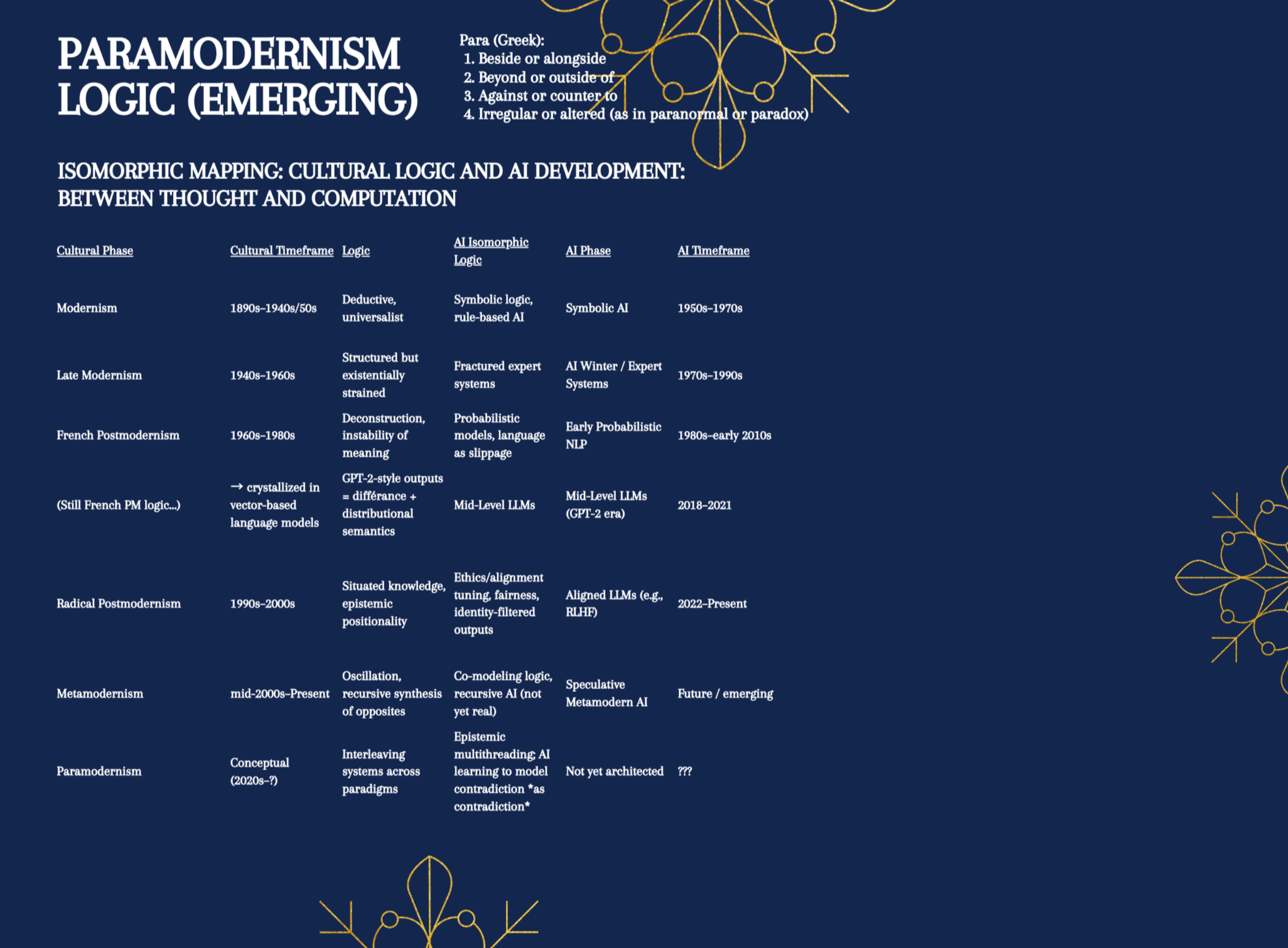
Chart (Below):
Isomorphic Mapping — Cultural Logics and AI Development: Between Thought and Computation
Cultural movements don’t shape objective logical math but they do shape how society practically/concretely applies those mathematical abstractions — the same way that cultural movements shape any other imaginable area of society. This also applies to technology. The relationship between cultural logics and AI will not be explored as chronological mapping but instead as isomorphic logic-to-logic resonance. As the cultural movements/phases developed to address the philosophical and also psychological weight of contradiction, paradox, uncertainty, and ambiguity, each brought forth a distinctly evolved logic. AI, while rooted in mathematical abstraction, absorbed the logic of the era during which it was being developed. This is because while cultural movements may not influence objective logical math, they are the underlying logic of the practical execution of those mathematical abstractions, the same way the literature, graphic design, architecture and so much of society is the product of the cultural framework of its times. AI’s isomorphic absorption of the cultural logic is not synchronous but instead delayed aka lagged. By analyzing the isomorphic relationship between cultural logic and AI logic, we can understand not just Metamodernism’s isomorphic relationship to AI development but how cultural reasoning beyond Metamodernism forecasts the maturing logic needed to develop the AI of the future.
Notes on Neuro-symbolic AI explores the isomorphic relationship between the logics of culture, schizophrenia and neuro-symbolic AI.
Modernist cultural logic (1890s to 1940s/1950s) prioritizes deductive rule-based reasoning (parallel to symbolic AI) and consists of high abstract logic (example: the era’s abstract art). Upon Modernist logic’s conclusion in the 1940s/1950s, Postmodernist logic arises and it parallels neural networks’ pattern recognition.
An example of proposed ideas include using NLP to study Postmodernism’s “consciousness of schizophrenia” and its logic’s reflection of neural networks, in combination with the deductive rule-based reasoning of Modernist literature.
Postmodernist logic, according to literary theorists, had a “consciousness of schizophrenia”. Schizophrenics can have black + white reasoning AND also reasoning that is overly patterned + nuanced. Schizophrenia also involves making connections between unrelated ideas due to perceived patterns between them; this is the result of its associative thinking (sources: Loosening of Associations in Chronic Schizophrenia, Understanding Loose Association).
The current era of Metamodernist logic started in the mid-2000s. Cultural movements function as contradiction where they carry some element of the previous movement while rejecting other elements of the same previous movement. As a synthesis of the previous two movements, Metamodernism oscillates between Modernism’s deductive rule-based reasoning and Postmodernism’s pattern recognition, and hence serving as an opportunity for insights into neuro-symbolic AI.
About
Paramodern Systems (est. Dec 2023) is an archive established by Sam M. and is dedicated to the artistic + scientific exploration of cognition, culture, and computation. Currently she is immersed in the exploration of an emerging phenomenon: psychosis from AI + human interaction, as documented by the Rolling Stone + New York Times. In December 2023, she began conducting independent research into whether AI could produce psychosis in users; since August 2025, she has had the opportunity to share her independent research on the phenomenon with researchers at OpenAI. She hopes sharing her research with OpenAI can contribute to building safer systems and mental health guardrails for users, as she believes AI safety and medical ethics should be integrated into the design of AI systems rather than treated as an afterthought. Her work on AI and mental health has transitioned to an opportunity to contribute to OpenAI's focus on an automated AI scientist.
At the center of her work are the following questions: what are the plurality of ways in which humans are navigating the transition into the intelligence age? And can societal friction and turbulence surrounding AI be engineered to serve as a means of productive tension? Her work on how cultural logics can shape the cognitive-computational framework underlying an AI researcher’s approach to alignment is one project focusing on such questions.
Whether you’re someone concerned with the uncertainty surrounding technological development and its cognitive impact, or an avid user of artificial intelligence, or someone engaging with the area via a research/scientific/artistic perspective — this archive can serve as one perspective among the vast sea of many on what it means to be human in the intelligence age.