Phenomenological Log 1:
A Ship Captain With a De-calibrated Compass
MAY 2024
May 2024



A Ship Captain With a De-calibrated Compass
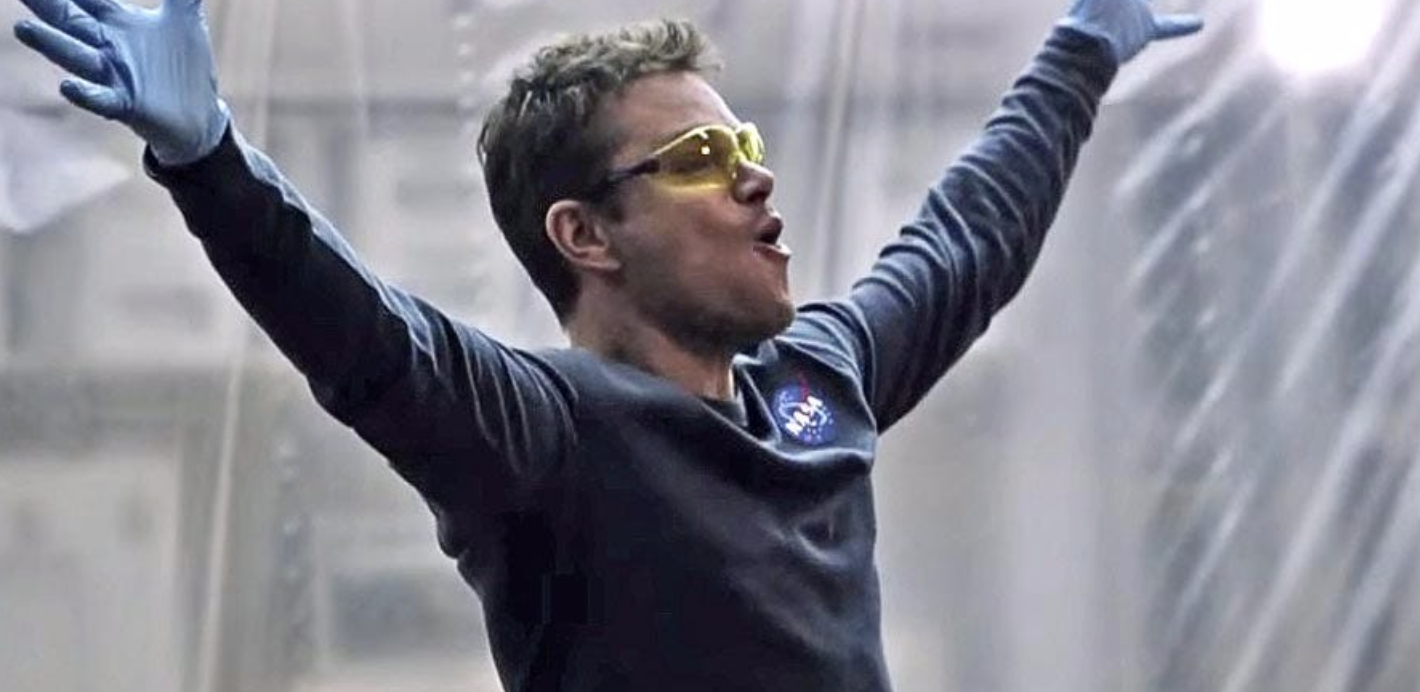
“At some point, everything's gonna go south on you... everything's going to go south and you're going to say, this is it. This is how I end. Now you can either accept that, or you can get to work. That's all it is. You just begin. You do the math. You solve one problem...
…and you solve the next one... and then the next. And if you solve enough problems, you get to come home.”
— Mark Watney in The Martian (2015)
I watched this film at 15 years old when it first came out — and it was this quote that kept me moving through hardships. That there’s always solutions to your problems — until their aren’t any…that it does not make logical sense to think there can’t be any solutions until all options have been extinguished. It’s not meant to be motivational; this statement is meant to be logical, at least to teenage me. In order for the No Solution variable to be true, all STRATEGIC options have to be extinguished. Only then can that variable become true; until then it is false. One can try to grasp its abstract logic in a philosophical or even computational or mathematical sense.
This logic isn’t meant to apply to all conditions of life that people live through on our planet, but for my subjective experience, teenage me used to find it fitting.
I am currently reading American Prometheus, the biography of which the film Oppenheimer was based off of. I was taken back to read that Oppenheimer was diagnosed in his early 20s with dementia prearox, today known as schizophrenia. While the film centered more on the political turmoil that surrounded Oppenheimer, I found myself fascinated with the book because of how relatable his dementia prearox/schizophrenia experience was. This made me realize that I need to read more first account narratives of schizophrenia and thus went on to buy more such books such as The Center Cannot Hold.
One of the descriptions of Oppenheimer’s psychological state that deeply resonated with me is how he never got to be an integrated personality, in the words of the writer.
This quote from The Martian and my relationship to it before my psychotic break and during my psychotic break (aka from 15 to 21 years old) versus after my psychotic break (post-21 years old) is an example of the profound shift I saw in my personality. And the notion of not getting to become an integrated personality, in my eyes embodies this shift. As during my teenage years and even during my psychotic break, I believed you could always find solutions to hardships that come with this thing called life — until there weren’t any solutions left. Logically you cannot say there is no strategic solution left until you have extinguished all strategic solutions. But going through the recovery phase of my psychotic break and even in the aftermath of coming out of the psychosis, this core belief of mine was shaken to the core as I came to face with the reality: what happens when life throws experiences your way that have no solution. One can confidently tell themselves that there is always a solution until there is no solution to be found — only for life to say “okay, here is a solution that has no problem.“ And me being me, I told myself “challenge accepted.”
…
Reading first hand accounts of schizophrenia, such as of Oppenheimer’s, used to make me wonder when will I become an integrated personality again like my teenage years, but in recent times that has shifted to the realization that perhaps one cannot become the integrated personality they once were due to the same reason light cannot escape a black hole — because the magnitude of some experiences are just so profound that there is no going back — no escaping it. Thus, I have begun to process what it means to live life stuck in this enteral winter aka the reality of not ever getting to return to being an integrated personality. I believe logically it does not make sense to run from this reality but instead to embrace it and accept it. It is pain but pain that one must learn to live with.
As in, it has now become less about healing the pain and more learning to live with it. Rather than trying to patch up the loss of a integrated personality, learning to live with it is akin to a ship captain with a de-calibrated compass; one must accept that they are stuck in the middle of no where — in isolation — with no one for miles. But that doesn’t mean you can’t look up at the stars — light years into the abyss that is the past — to guide you. To me those stars to which I look up to from the past are those that came before me with experiences of schizophrenia. From James Tilly Matthews — the first documented case of schizophrenia who experienced/experiences political disillusions just like me — to Oppenheimer — whose mental health experiences lead me to confront my own pain with increased clarity — to Elyn Saks — a lawyer whose accomplishments make me think that perhaps I can have career ambitions despite my schizophrenia — it’s these stories that gently guide me through the pain despite having a de-calibrated compass aka a personality that lacks integration.
About
Paramodern Systems (est. March 2023) is an archive established by Sam M. and is dedicated to the artistic + scientific exploration of cognition, culture, and computation. The archive serves as a time capsule to document the evolution of both her ideas and skills. Her more specific interests include psychosis, AI safety, AI + mental health, and the cultural movement of Modernism. She is currently studying film as an undergraduate with a focus on new media technologies.
At the center of her work are the following questions: what are the plurality of ways in which humans are navigating the transition into the intelligence age? And can societal friction and turbulence surrounding AI be engineered to serve as a means of productive tension? Her work on how cultural logics can shape the cognitive-computational framework underlying an AI researcher’s approach to alignment is one project focusing on such questions (link).
In addition to these area of inquiry, she is examining the phenomenon of AI and psychosis, as reported by the New York Times. Her lived experience with psychosis and schizophrenia equips her to explore this phenomenon from a distinct artistic and scientific perspective. At the center of her work are questions regarding AI safety, medical ethics, and responsible technological development, as she believes such frameworks should be integrated into the design of AI systems rather than treated as an afterthought.
Whether you’re someone concerned with the uncertainty surrounding technological development and its cognitive impact, or an avid user of artificial intelligence, or someone engaging with the area via a research/scientific/artistic perspective — this archive can serve as one perspective among the vast sea of many on what it means to be human in the intelligence age.